

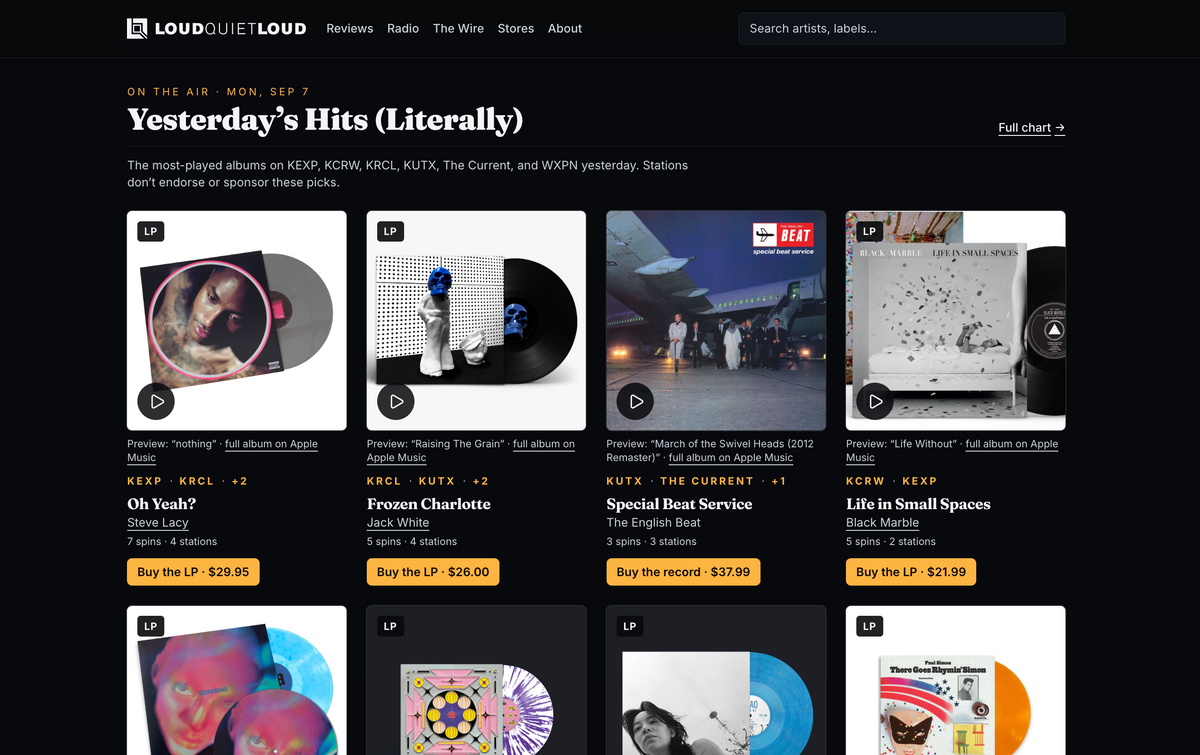
We built something for the fun of it, and it is live at loudquietloud.shop.
LoudQuietLoud takes what critics and public radio are actually playing this week and connects it to the records you can buy. Then it does the part we care about: it sends you to the artist's own store, or the label's, or an independent shop's. Not to a marketplace listing. Not to a big box retailer who happens to stock it. To the source, wherever there is a source to send you to.
It holds no inventory, runs no checkout, and has no accounts. Click to buy and you are on the merchant's own Shopify store, paying the merchant.
Why we built it
Shopify talks about arming the rebels. Harley Finkelstein says it often enough that it has become shorthand for the company's whole reason for existing: independent operators should have the same tools as the giants, and the giants should not get to own the customer relationship by default.
This is our small version of that idea.
We believe independent artists, labels and record stores can keep meaningfully more of their revenue by selling direct, and that most of them are leaving that money on the table by treating their own store as an afterthought behind a streaming link or a marketplace listing. That is not a hunch. It is what fifteen years of building for labels has shown us, and what our own client work keeps proving. When Polyvinyl Records moved off a legacy CMS onto one Shopify store serving both direct-to-fan and wholesale, revenue went up 20%.
So the question we wanted to answer was a practical one. If a record buyer is going to discover something new this week, from a review or from radio, can you put the artist's own store in front of them at that moment instead of the default? We wanted to find out what that actually takes to build.
The other half of the reason is that we wanted to learn a new API by using it. Shopify's Global Catalog and the Universal Commerce Protocol are the newest layer of the platform and the documentation is thin, because almost nobody has shipped anything real on it yet. Reading a spec teaches you the shape of a thing. Building a live product on it teaches you where it breaks. We would rather be the agency that already knows.
It is a side project. It may make a little money through affiliate commissions, and there is a disclosure on the site saying so. That was never the point, and this post is part of the project too: building in public, so the useful parts are out where other people can use them.
How it works
Three things running together.
The first is a map of how music connects. Artists, labels, side projects, band members, scenes, assembled from three public music databases and rebuilt every week. This is what lets you pull a thread from a band you already love to a label you have never heard of, which is how people who buy records actually shop. Nobody types "12-inch LP" into a search box.
The second is what is happening right now. Two automated jobs pull album reviews from five music publications and yesterday's most-played albums from six public radio stations. Each is credited with a headline, a sentence, and a link back to the publisher. None of them is a partner or a sponsor. They are public feeds, used with attribution.
The third is where the buying happens. Every "buy" link is a live listing from a real store, pulled from Shopify's Global Catalog. The directory currently covers 120 independent labels, artist stores and record shops, 112 of them labels.
What the Global Catalog is
The Global Catalog is Shopify's cross-merchant product index. It lets an application search products across many independent Shopify merchants at once, instead of one store at a time.
It is reached over the Model Context Protocol, the same interface AI agents use, under Shopify's Universal Commerce Protocol agent profile. That is the sentence worth sitting with. When a customer asks an AI assistant to find a product, the assistant does not browse storefronts one at a time. It queries an index. The Global Catalog is that index for Shopify merchants.
Which means an independent merchant in that index can be found in places their own storefront will never appear. That is the part that should interest anyone selling direct, and it is also where the trouble starts.
What we actually learned: the data is the product
We expected the hard part to be commerce. It was not. Shopify handles commerce. The hard part was identification, and almost none of it was under our control.
Search a cross-merchant catalog for the band Broadcast and you get a "Live Broadcast" album by somebody else. Search for the label Domino Records and you get a Fats Domino record. The match comes back confident and completely wrong. Not because the Catalog is bad at its job, but because a product title is a sentence, and a sentence does not tell you what a thing is.
We ended up writing a validation layer that checks every product against what we know about the artist before it appears anywhere on the site. That layer exists because merchant data is inconsistent. Some stores structure a release properly. Plenty run the artist, the album, and the format together in one title field and leave everything else empty.
We were the system doing the matching, and we could only ever be as good as the data we were handed. That is the part worth passing on, because in the version that matters to you, the system doing the matching is an AI shopping agent, and the data it is handed is yours.
How the Catalog decides what your product is
This is documented, and it is worth reading carefully if you sell on Shopify.
Results in Shopify's Global Catalog are clustered by Universal Product ID, which means your listing is not evaluated alone. It is grouped with other merchants' offers on the same product. Being identified correctly is what puts you in the right cluster rather than floating as an orphan listing nobody can compare.
Agents then narrow with filters that run on structured fields, not on your copy:
- Product category, as a Shopify taxonomy category. If yours is unset or wrong, category filters skip you. It compounds: the Catalog's relative price tier is calculated *within a product's category*, so a product with no category has no price position either.
- Attributes, where the supported names are Color, Size and Target gender. Shopify's documentation is blunt about the rest: unsupported attribute names are ignored. If your color lives in the product title or a custom metafield instead of a real product option, a buyer filtering for black in a size ten does not see you.
- Rating and review count, as a minimum value and a minimum number of reviews. A store with no collected reviews is excluded by that filter entirely, however good the product is.
- Condition, availability, and where you ship from and to.
And then the line that should decide your next quarter's data work. Shopify's own guidance notes that some catalog fields are inferred by its AI, and that those inferred fields "might not always be present or have varying accuracy depending on available product data."
Read that plainly: whatever you leave empty, something else fills in, with accuracy that depends on how much you gave it to work with. You are not choosing between filling in your data and leaving it blank. You are choosing between describing your own product and letting a model guess.
The fixes that stop working
Most stores have accumulated data workarounds that exist because a theme could render around them. A front end is forgiving. An index is not.
The common ones, all of which look fine on the storefront and disappear the moment something other than a browser reads the page:
- Size, color or format written into the product title instead of existing as real product options. Human-readable, machine-invisible.
- Specs and dimensions living in an image. A spec table saved as a JPEG is not product data. Nothing can read it.
- A metafield only the theme knows about. If the only consumer is your own Liquid, the value does not exist anywhere else.
- The empty barcode field. That is where the GTIN goes, and it is the identifier that lets the same physical product be recognized as the same product wherever it is sold. Most stores leave it blank or paste a SKU into it.
- Duplicate products from an old import or migration. Three listings for one product means three competing answers to what you sell, and nothing to arbitrate between them.
- Category left at whatever was assigned on import, which is usually nothing or something close.
None of this is glamorous work and all of it is cheap compared to a redesign. It is also the kind of thing that quietly never gets scheduled, because nothing on the storefront looks broken.
Why this matters more for independents than anyone else
Here is the uncomfortable version of everything above.
A big box retailer has a merchandising team, a data team, and a vendor feed that arrives with GTINs, categories and attributes already populated because their suppliers are contractually required to send them. Their listings cluster correctly. They pass every filter. They show up.
An independent label has one person doing everything, a catalog imported from whatever came before, and a product title that reads the way a human would write it on a shelf tag. The record is better. The listing is invisible.
That gap is not about budget or talent. It is about which fields are filled in. Which makes it one of the few advantages in ecommerce that an independent can simply take, this quarter, without outspending anyone. Correct categories, real product options, populated identifiers, no duplicates, current structured data. The same discipline that makes a catalog legible to a discovery layer is what makes it legible to an AI assistant, and both of them are increasingly deciding who gets the sale.
We built LoudQuietLoud to point buyers at the source. What we learned is that the source has to be findable first, and right now most of them are not. That is fixable, and it is the most direct thing an independent can do to keep more of its own revenue.
We have written the merchant-side checklist up in more detail in our post on getting a Shopify store ready for AI agents.
Softlimit is a Shopify Premier Partner. We have built and maintained stores for labels including Polyvinyl Records and Sacred Bones Records. If your product data has been collecting workarounds for a few years, that is worth a conversation. Get in touch.
FAQ
What is Shopify's Global Catalog?
Shopify's Global Catalog is a cross-merchant product index that lets an application search products across many independent Shopify merchants at once, rather than querying one store at a time. It is reached over the Model Context Protocol under Shopify's Universal Commerce Protocol agent profile, the same interface AI shopping agents use to find products across Shopify's merchant network.
Does LoudQuietLoud sell records?
No. It is a discovery layer. Click a product link and you go to the artist's, label's, or independent shop's own Shopify store, and you pay the merchant there. LoudQuietLoud holds no inventory, operates no checkout, and has no accounts. It may earn a commission on purchases made through its links, and that disclosure appears on the site.
Is LoudQuietLoud affiliated with Shopify?
No. It was built by Softlimit, a Shopify Premier Partner agency, on Shopify's Global Catalog, which is a publicly documented commerce API any developer can build on. Shopify does not endorse, sponsor or partner on LoudQuietLoud. Softlimit holds Premier Partner status separately, through Shopify's partner program. The two facts are unrelated.